Sunday, March 18, 2012

Death Valley National Park

We're currently in Escondido, a suburb of San Diego.  We spent the last three nights at Death Valley National Park, and, on the whole, we were rather glad to get out of there!  It's a desert, fine, and we've been in a number of deserts on this trip.  It has a reputation as being the most inhospitable place in America - the lowest point (282 feet below sea level) and the hottest place (137 degrees on a July day a number of years ago).  But we would be there in March, during the desert spring, and everything would be wonderful.  Well, not quite.

We arrived on Thursday.  The park is the largest national park in the lower 48 states.  In summary, it's a long valley (a lake from years and years ago) with mountain ranges to the west and east.  Because of the western mountain range, the average rainfall is less than 2 inches per year, so there is not much vegetation.  As we entered the park we drove down and down and down.

Our campsite had not "hookups" - for water, or electricity, or septic - so we were self-contained with the fresh water we carried in the RV (about 60 gallons).  The first night was pleasant - no highway noise or railroads for a change.  On Friday morning we drove to Badwater Salt Flats, the lowest point in the park.


We took a short hike up Natural Bridge Canyon.


The rock in this area is called "conglomerate" and it's a mixture of sand and small stones/rocks.  I guess it's easily eroded by the thunderstorms that happen in the winter.  And the water that runs down the mountain sides and into the canyons are carrying the stand and stone and so it has even more erosive power than water alone.  Throughout the park there are places where you can see the runoff of stones and sand coming out of the mountains.  These are called alluvial fans and we impressed each other over the next two days by speaking very knowledgeably about "alluvial fans."  Ha!

Here's an example.
 

We also drove through an area known as Artist's Drive with very colorful rocks.  The rocks in this area are a mixture of sedimentary and volcanic.  The colors come from minerals in the rock.


Anyone of a certain age is sure to remember the TV show "Death Valley Days," and especially the host from that show - Ronald Reagan.  It turns out he only hosted for two years, 1963 and 1964, but it seems part of American culture, along with the show's sponsor, 20 Mule Team Borax.  Well, we were able to see some of the remaining wagons and processing areas.  They would use two wagons to carry the Borax and a tank of water for the trip through the desert and over the mountains.

Some things that the TV show didn't mention was that most of the labor of processing the Borax was performed by Chinese laborers who were paid $1.60 a day (and a housing allowance was taken out).  Also, the work could not be done in the summer because the chemical process of separating the Borax cannot take place at 120 degrees!

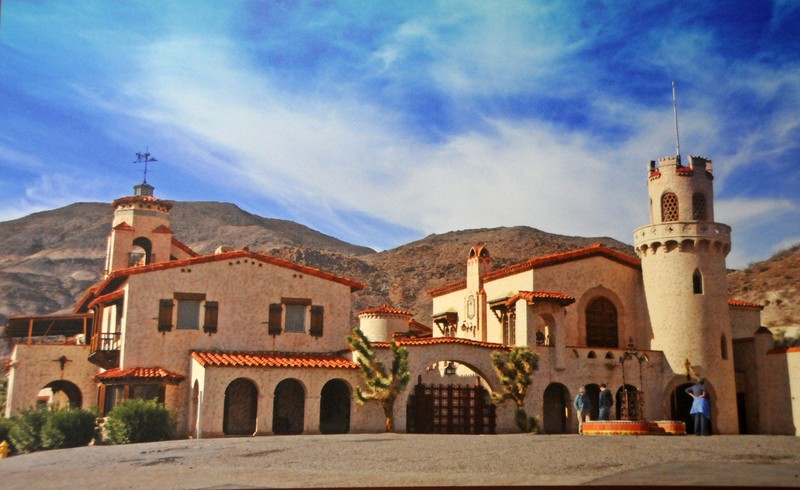
During our second night a very strong wind blew all night, with occasional gusts sending sand and stones against our RV.  The wind continued the next day as we drove a Chicago millionaire's home known as "Scotty's Castle."  Scotty had been a cowboy with the Buffalo Bill Wild West Show for a number of years and then he started bilking people for money.  He claimed to be prospecting for gold in Death Valley but he just spent whatever money was given him.  One of his investors came to Death Valley to find out what was really going on.  He loved the environment and the "wild west" and ended up building this house and forgiving Scotty the money he had squandered.


We also visited an old volcano called Ubehebe Crater.  This crater was formed by an explosion of water and magma.

As we returned to the RV camp we drove through a number of places with major dust storms.

We considered leaving the park but the rangers said the wind was 20 MPH worse outside the park!  Fortunately the winds died down during the night and we left in the morning, happy with what we had done but somewhat disappointed with the bad weather.

Thursday, March 15, 2012

California and Joshua Tree National Park

After weeks and weeks in Texas and Arizona, we finally made it to California!  Matthew was especially happy to apply a new state sticker on the map on the outside of the RV. (And to put on some shorts!)

While driving through California we frequently thought about how we were seeing parts of the state that most tourists don't get to - with good reason!  There is so much of the eastern part of the state that is just mountains and desert!  As we drove west we approached Palm Springs and came across a huge windmill farm.  This is just a little south of the national park and we learned later that they are located on top of the San Andreas fault!
Our RV campground was inside Joshua Tree National Park.  It was up a sizable hill and we had a great view of the town in the valley.  We were surrounded by Joshua Trees.

For the first time on the trip we had a camp site without "hookups" - water, electric, and septic connections.  So, we were closer to true "camping" than usual.  We had a wood fire and cooked dinner on it one evening.

The Joshua Tree is a member of the Yucca family and technically not a real tree, but it has a single trunk and multiple branches.  The leaves are small and sharp.  The National Park is known for the large concentration of Joshua Trees here but also for unusual rock formations.  These are the result of magma forcing itself up through softer rock and hardening.  The softer rock has eroded and left the granite.  The park is very popular with rock climbers.


 Matthew was very good at it.

Bill tried and got stuck - kind of like between a rock and a hard place.
We had a great time doing some short hikes and having a picnic.  We really enjoyed photographing the many cacti and their unusual shapes.  We also saw a number of cacti in bloom.


We were fascinated by the unusual rock formations.  Here is an example of a line of some minerals (quartz?) inside the granite.

Joshua Tree NP is also interesting because it has two different types of desert:  the Joshua Trees grow at a higher elevation and are classified as part of the Mojave desert, while at lower elevations the desert is considered a Sonoran desert.

We're all learning so much and, as usual, Matthew was able to get another Junior Ranger.  This was number 22 for this trip!

Monday, March 12, 2012

Grand Canyon

From Flagstaff we drove north to Grand Canyon National Park.  This seems to be on everyone's "must see" list.  There were many visitors from around the world - we talked with a couple from Australia and it was common to see Japanese people or overhear people speaking French or German.

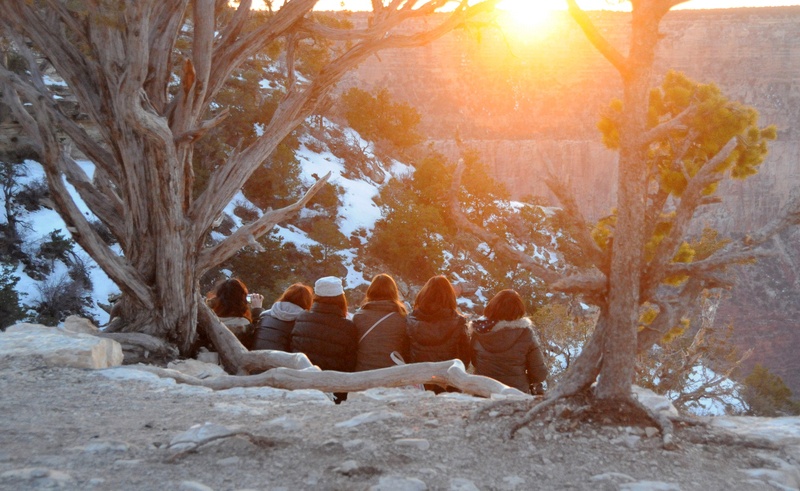
We arrived in the late afternoon and were informed about viewing the sunset.  Oh, no, we expected another disappointment like Sedona!  Well, once again, we watched the sun set as we got colder and colder and the surrounding area just got darker and darker.  No spiritual events, no glowing skies or canyons.


As you can see, there were many others sharing the same experience.  There was one group of young Japanese woman who, to pass the time, would jump in the air and try to capture it with a picture.  This was fairly close to the edge.
 The Japanese group eventually settled down...

On Saturday we took a short walk with a Ranger and learned some of the history of boating on the Colorado.  To get an idea of the speed and strength of the Colorado River, the Mississippi has a drop of 6 inches per mile while the Colorado drops 8 feet!  The shortest ride through the park is 4 days, camping by the river side each night.

We took tour buses to various lookout points, but never ventured over the edge.  Perhaps Matthew's favorite memory will be lunch at El Tovar, this classy hotel built in about 1905 by the Santa Fe railroad and run by the Fred Harvey company.  He got a dessert with an edible spoon!


 We saw quite a bit of wildlife - elk, a coyote, mule deer, and a California Condor.  These are being reintroduced into the canyon and are being monitored closely by the park service.  You can see the tag on this guy's wing.
We soaked up lots of geology and local lore about some of the early promoters (the famous Kolb brother photographers, for example).
Fred Harvey's hotel/restaurant operation and the famous "Harvey Girls."
And the architect Mary Colter, who designed some of the local buildings as well as others for the Harvey organization (for example, La Posada, which I wrote about in Winslow).  Here is the famous Hopi House, a gift shop based on local designs.
There are so many things about the Grand Canyon that are kind of mind-boggling such as the size and colors.  Another interesting thing is the age of the rocks.  The rocks at the bottom are 1.8 billion years old, half the age of the earth, more or less.  And at the top, it is estimated that over 5,000 fee of stone and soil has already eroded.  That is, there are no fossils of dinosaurs in the top layers because any rock with those fossils are already gone.

A few more images.
 You can see the river (with rapids) in this one.